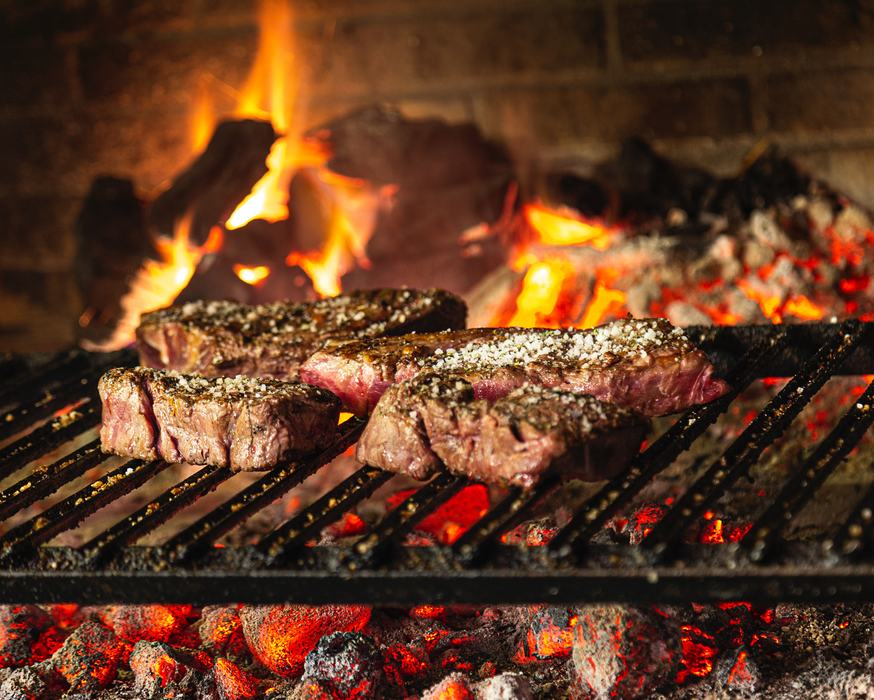
May is Beef Month and grilling season is upon us. Have you ever thought about what it takes for you to eat a juicy hamburger or a sizzling steak? In the next few months, you will be enjoying these and many other cuts of beef and we would like to provide you with information that helps you understand what goes into getting those delicious and nutritious foods on your plate.
The US cattle industry is divided into 3 main sectors: (1) Cow/calf sector, (2) backgrounding or stocker phase, and (3) finishing phase. Each of these sectors can be broken into 6-month time periods, with total time from birth to plate being around 18-20 months.
The cow/calf and backgrounding sectors are the most common in North Carolina because they utilize forages (pasture grasses) as the primary source of feed. The climate and soil type here is perfect for growing a variety of forages that are excellent feed for grazing cattle. Alternatively, the typical finishing phase uses large amounts of feed grains that aren’t available in North Carolina in the volume required, so that is why most of these operations are found in the midwestern United States, also known as the “corn belt.” You will find several pasture-finished and grass-finished operations across North Carolina that have been very successful in marketing locally raised beef.
Recent agricultural statistics data reported around 410,000 beef cows in North Carolina. As stated above, the majority of these cattle fall into the cow/calf sector. Cattle producers in this sector have a goal of producing feeder calves to sell to backgrounding operations. This provides most of these farmers with supplemental income but, in some cases, their only income. These feeder calves are sold in a variety of ways, but the most common ways are through local auction markets and/or value-added sales.
Factors that affect profitability in a cow/calf operation include, but are not limited to, days of grazing (which drastically affects feed costs), calving percentage (the number of calves born versus number of cows exposed to a bull for breeding), and weaning weights (what the calf weighs at the time of sale). Forage is the foundation for it all. Producers who strive to manage their operations in a way for cattle to have constant access to good forage tend to have healthier cows that will breed and have a calf, that will provide enough milk for that calf to grow and develop, and to wean a calf that is heavier than those that don’t have access to good quality forages. Producers get paid in dollars per pound, so the heavier the calf, the more money they make.
Backgrounding is often defined as the process of growing and developing calves from weaning (450-600lbs) to yearling (700 to 850lbs) at which point the calves are ready to enter the finishing phase. These operations are typically more profitable when they start with lighter, thinner calves that will respond to a higher quality feed source that will help them grow and develop. Goals for these operations are to add 200 to 300 pounds of weight per calf, provide these calves with constant access to high-quality forages rather than expensive high-energy feed sources, and market these animals in groups that are uniform in gender, weight, and quality. Much like a teenager, these calves should be provided high-quality nutrition in order for them to reach their potential and grow efficiently.
The finishing phase is the sector that takes these yearling cattle and feeds them a diet higher in grain in order to add fat to the animal. This fat is called marbling and affects the taste, tenderness, and grade on a beef carcass. These cattle typically go to a finishing operation weighing 750 to 850lbs. They will gain on average around 3lbs per day and finish around 1250 to 1400lbs. Smaller framed animals will require less time to finish and larger framed animals will require a longer period of time. Most of these cattle are fed in the Midwest in feeding operations because those operations are closest to high volumes of grain.
Some producers in North Carolina have taken advantage of consumers’ desires to buy locally raised beef. Some of these producers “pasture-finish” cattle on high-quality forages and supplement with grain in order to get the desired marbling that their customers ask for in their product. Other producers finish their animals completely on forages and market their product as grass-fed beef. These animals tend to take longer to finish because they aren’t pushed to grow faster with a supplemental diet. Both of these types of finishing operations have proven to be profitable, but also require additional levels of time and management.
We realize there are many questions from you as consumers about each of these segments and concerns about how cattle are treated. N.C. Cooperative Extension agents across the state and country are trained in Beef Quality Assurance (BQA). BQA is a nationally coordinated, state-implemented program that provides systematic information to U.S. beef producers and consumers on how common-sense husbandry practices can be coupled with scientific knowledge to raise cattle under optimum management and environmental conditions. We strive to teach BQA principles in every educational program we provide to help ensure that you as a consumer feel confident in the product you are purchasing and can trust and have confidence in entire industry.
If you, as a producer or consumer have questions pertaining to beef cattle production, feel free to reach out to us at the N.C. Cooperative Extension, Rutherford County Center at (828) 287-6010. In the meantime, we hope you enjoy May Beef Month with your favorite beef recipes.