Strategic Management of Beef Cattle Systems Under Drought Periods
(Updated: Sept. 25, 2026, 3:13 p.m.)
As of May 1, 2026, the U.S. Drought Monitor indicates that North Carolina and other states in the Southeast are experiencing moderate to extreme drought conditions, with some areas breaking historic records. Under these challenging conditions, it is crucial to develop a management plan based on the strategic use of resources to help farms navigate the drought period.
Pasture And Grazing Management
Implement fast grazing until forage stands are down to 3-4” across all pastures. This will allow the soil to remain with good coverage and the plants to maintain a deep root system. Avoid overgrazing at all costs!
After all pastures have been grazed, move cattle to a sacrifice pasture to feed them hay or other available roughage.
In endophyte-infected (i.e. Kentucky-31 Tall Fescue) pastures where seedheads have already developed, supplement cattle with protein (pellets or tubs) and ensure permanent access to shade and water to reduce the negative effects of fescue toxicosis and heat stress.
Test fresh-cut hay or roughages for nitrates before feeding them to cattle. With forage grazing, adapt cattle by slowly introducing them to suspect pastures, limit daily intake and gradually increase grazeable area over time.
Limit animal intake to extend feed inventory while ensuring cattle health and proper body condition (score of 5 in a 1-9 scale).
Culling and Selection Criteria for the Herd
Cull cows and heifers that:
Keep cows and heifers that:
·Fail to become pregnant when exposed to a bull during the breeding season.
·If using only artificial insemination, are not pregnant by the second round.
·Have a history with prolapse or calving difficulties.
·Do not raise a calf that meets the weaning weight goal.
·Shed their winter hair coat late into the summer or fail to shed at all.
·Maintain a low body condition score throughout the production cycle.
·Exhibit aggressive behavior.
·Are pregnant.
·Have a proven record and sound genetics.
·Start shedding their winter hair coat early in the spring.
·Maintain higher body condition scores throughout the year.
·Become pregnant earlier in the breeding cycle and wean heavier calves.
·Maintain a good disposition
Evaluating Hair Shedding and Body Condition
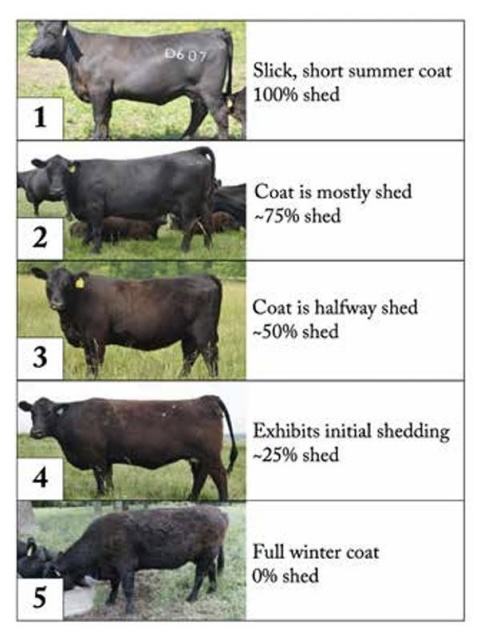
Hair shedding is evaluated using a 1–5 scale, where a score of 5 indicates an animal that retains its full winter hair coat with no evidence of shedding, and a score of 1 represents an animal that has completely shed its winter coat and exhibits a short, slick hair coat. Generally, cattle shed from head to tail and from top to bottom, beginning around the neck and along the top line. Evaluations should be conducted in May, as early shedding cattle should have a slick hair coat and will be easier to identify. Cows that do not begin shedding until the summer, as well as those that fail to shed at all, should be removed from the herd.
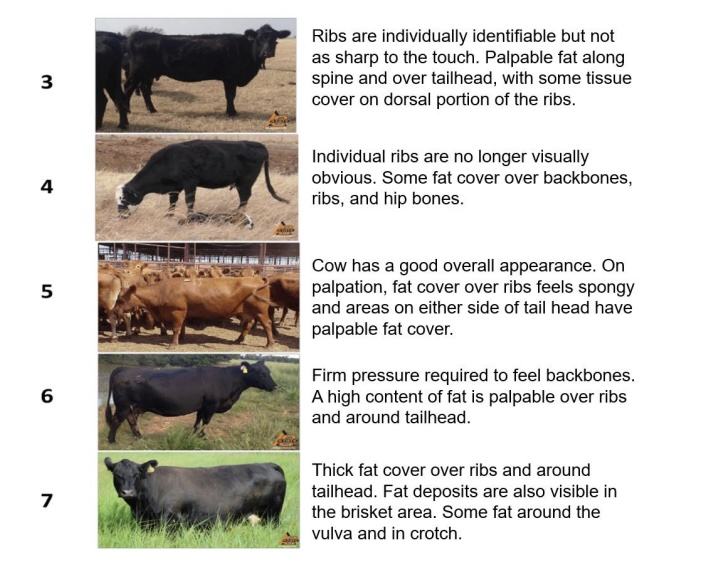
The body condition scoring system uses a 1–9 scale. The extremes of this scale should be avoided, as scores of 1 or 2 represent thin, malnourished animals, whereas scores of 8 or 9 indicate obese animals that are very expensive to maintain. Ideally, all animals in the herd should maintain a body condition score between 5 and 7 throughout the production cycle. Under drought conditions, a score of 5 is acceptable to ensure a good health status and proper productivity.